
Morris County Parole or Probation
Texas divides post-release supervision among separate agencies. Parole is a conditional release from TDCJ confinement before the sentence reaches its end. Mandatory supervision is another state release mechanism, subject to statutory eligibility and, for many later offenses, Board review. Both are supervised by the TDCJ Parole Division. Probation, formally called community supervision in Texas, is imposed by a court and supervised locally. A Morris County probationer may never have served a TDCJ prison term.
Do not infer the supervision type from the word “released.” A jail booking-and-release sheet can show that Morris County Jail custody ended, but the court judgment or TDCJ record explains what came next. A transfer to TDCJ is continued custody. A bond release leaves the case pending. Release to parole or mandatory supervision ends confinement for that sentence while state supervision continues.
| Point | Parole or mandatory supervision | Probation |
|---|---|---|
| Who authorizes it | Texas Board of Pardons and Paroles and Texas law | The sentencing court |
| Who supervises Morris cases | TDCJ Parole Division, usually Mount Pleasant DPO | Morris County CSCD |
| Best starting record | TDCJ identity, review, release, and office data | Judgment, docket, and CSCD confirmation |
| Prior prison required | Release follows TDCJ confinement | No |
| End point | Discharge or other formal termination | Court-ordered completion or termination |
- Parole
- Conditional release from prison before the sentence expires, with state rules and supervision.
- Probation
- Court-ordered community supervision, often used instead of confinement.
- Mandatory supervision
- A Texas release mechanism governed by eligibility law and, in many cases, discretionary Board review.
- Discharge
- The formal end of the identified sentence or supervision obligation.
- Absconder
- A supervised person whom the responsible agency lists as having stopped reporting or whose whereabouts are unknown.
Check Morris County Release Supervision
Verification works best as a record chain. Start with the source that can establish the sentence or release type, then contact the office assigned to that kind of supervision. Names alone are risky. Match the TDCJ or SID number, date of birth where permitted, cause number, conviction county, and offense history before accepting a result.
- Identify the custody and sentence. Obtain the Morris court judgment or sheriff release record. Decide whether the event was county probation, a TDCJ commitment, parole, mandatory supervision, or discharge.
- Check the state record. Use the TDCJ inmate search for a current state inmate and published parole-review or scheduled-release fields. An absent result is not proof of discharge because the public search is limited to current inmates.
- Use the correct office. Contact Mount Pleasant DPO for state parole or mandatory-supervision assignment questions. Contact Morris County CSCD for probation imposed by its participating courts.
- Read the court file. The County Clerk handles misdemeanors, while the District Clerk handles felonies and court orders. Read the signed judgment or order, not just a brief case-status label.
- Confirm the ending event. Ask for the record that states completion, discharge, revocation, or other termination. A release date alone does not prove that supervision ended.
The broader Morris County release-record path is available from the released-inmate search and records hub. It helps separate a county jail exit from a state release, a transfer, or a later discharge.
Morris County Probation Across Three Counties
Morris County Community Supervision and Corrections Department is not a parole office. It is a multi-county local department serving Morris, Camp, and Titus counties, the 76th and 276th Judicial District Courts, and the participating county courts. This structure matters when a judgment uses “community supervision.” The case remains tied to the sentencing court even if the person reports through an office serving more than one county.
The official Morris County probation page identifies the local department and its contact. Use it to ask whether the office owns the supervision assignment and what public confirmation it can give. For the legal basis and conditions, obtain the actual judgment from the proper clerk. Disclosure limits may prevent staff from giving a caller every condition or a live location.
Morris County CSCD
Chief Shane Winn
500 Broadnax Street
Daingerfield, TX 75638
Phone: 903-645-3166
Fax: 903-645-5560
The official page shown below confirms the local probation route. It is not a statewide parole lookup.
Open the Morris County CSCD source before using the contact information.
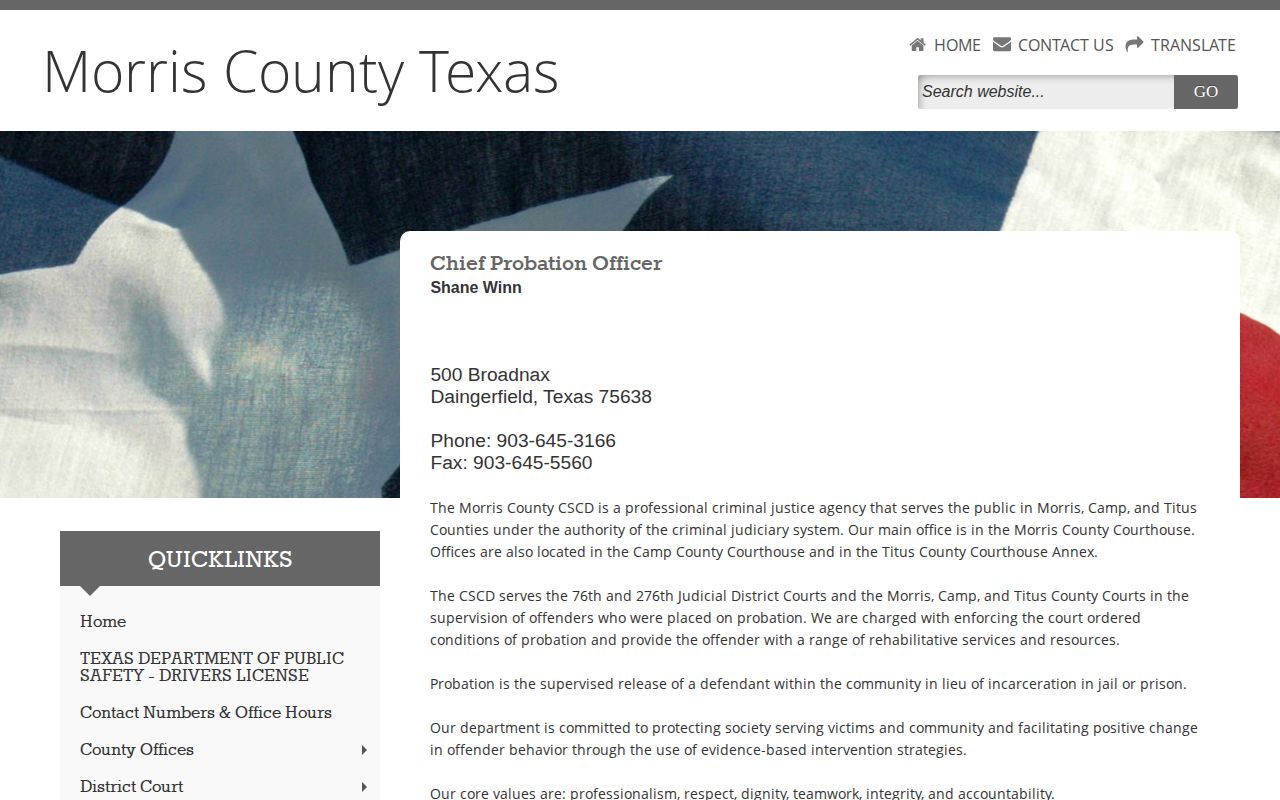
The image helps distinguish courthouse-based probation from TDCJ parole supervision.
Note: A probation record does not establish prior imprisonment or a TDCJ discharge.
Morris County Parole Goes Elsewhere
State parole and mandatory-supervision cases associated with Morris County map to the Mount Pleasant District Parole Office in TDCJ Region I. They do not map to the courthouse CSCD merely because the conviction arose in Morris County. The TDCJ county cross-reference provides the assignment, and the Region I directory provides the office contact.
Mount Pleasant District Parole Office
1814 Bill Ratliff Freeway
Mount Pleasant, TX 75455
Phone: 903-572-1679
Fax: 903-572-2139
The TDCJ county cross-reference below documents Morris County's Mount Pleasant assignment.
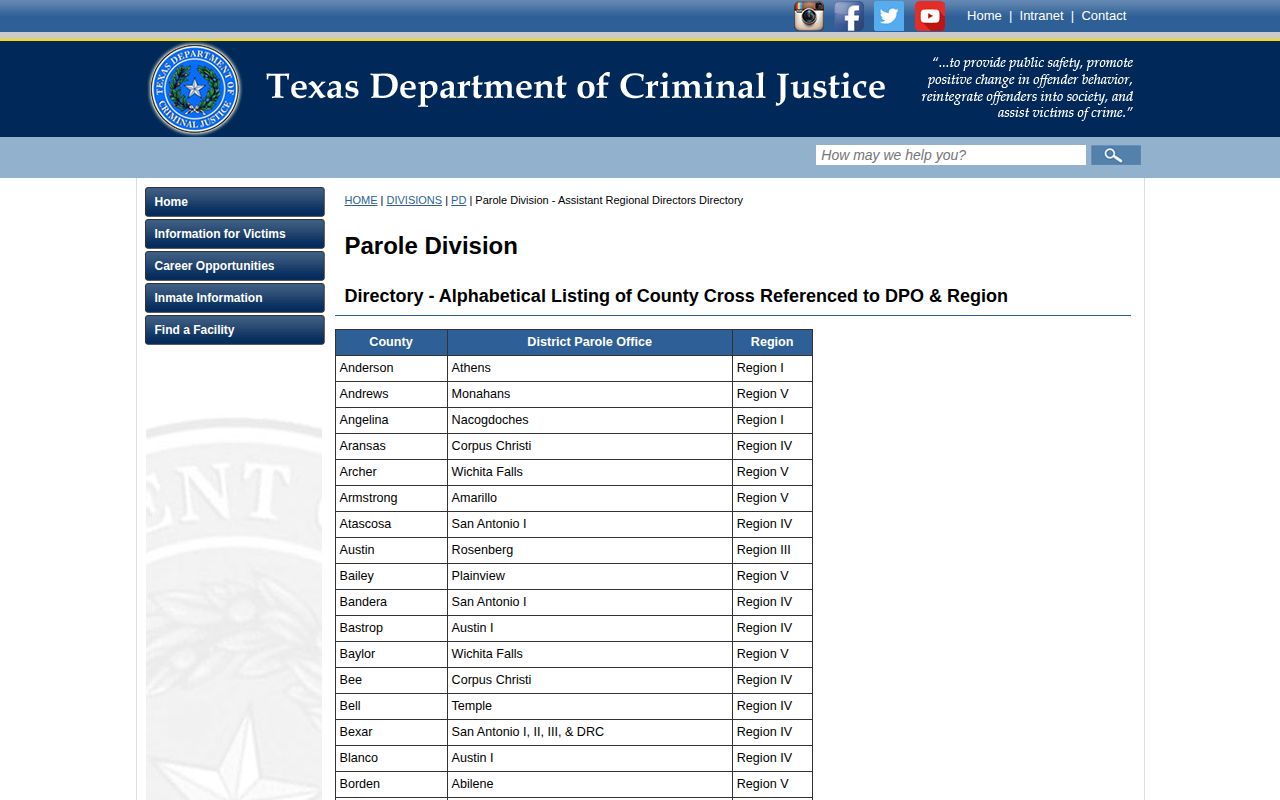
This mapping tells a caller which district office to contact; it does not disclose a person's conditions.
The Region I office directory provides the address and phone shown in the contact card.
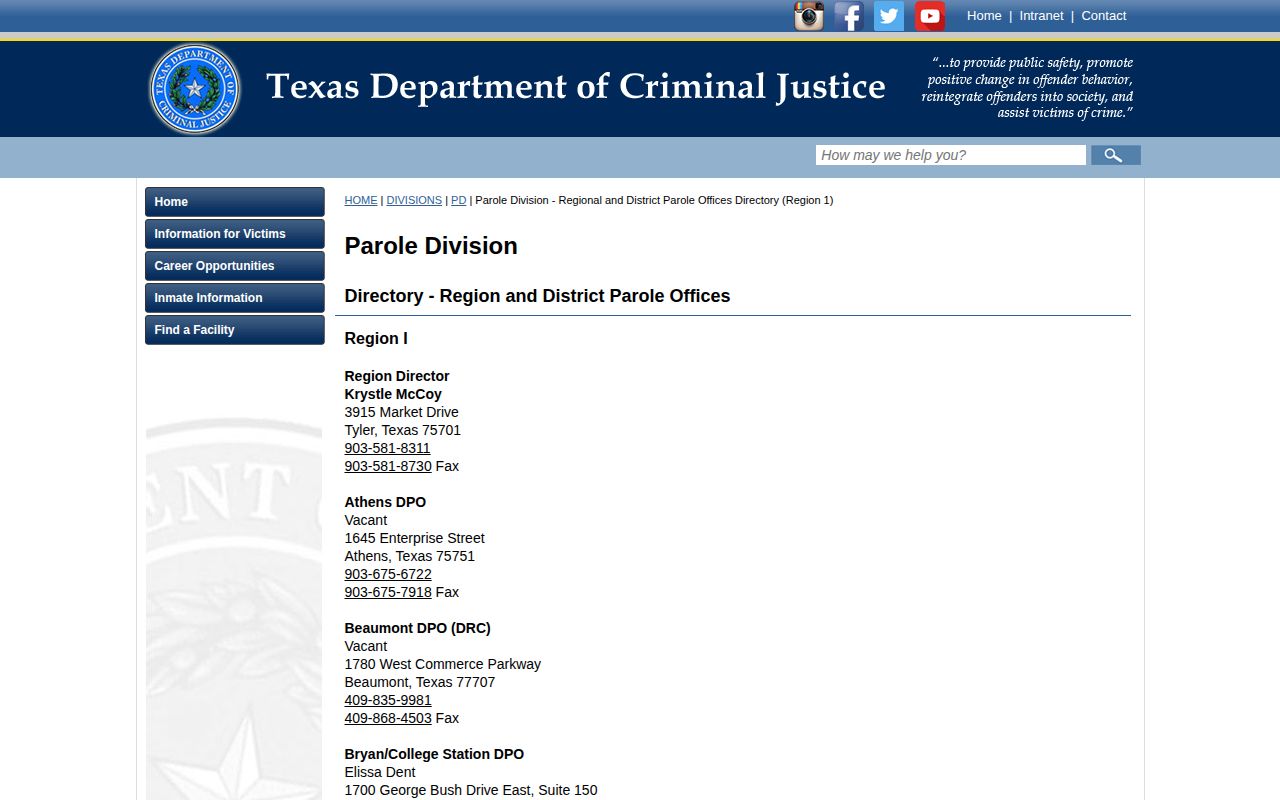
Use the directory to recheck the office before relying on saved contact details.
Morris County Parole Review Records
Texas does not use an ordinary public parole-hearing calendar for these cases. The Board's panel-review explanation says formal hearings are not held for routine parole and mandatory-release consideration. Panel members review and vote a file individually. An initial-review case may be identified about six months before eligibility, while a later review may be identified about four months before its review date. The overall review can take months, but those ranges are not hearing appointments or promised decision dates.
Read decision codes through the official vote-options key. FI-1 and FI-2 are favorable actions with distinct timing. Program-conditioned votes carry additional steps. RMS concerns release to mandatory supervision. NR can set a later review, SA can direct service of the sentence subject to mandatory-supervision law, and DMS denies mandatory supervision. “Approved” does not establish that the person has already left confinement. New information can also affect an approval.
The Board panel-review page captured below documents why no courthouse-style hearing calendar should be expected.
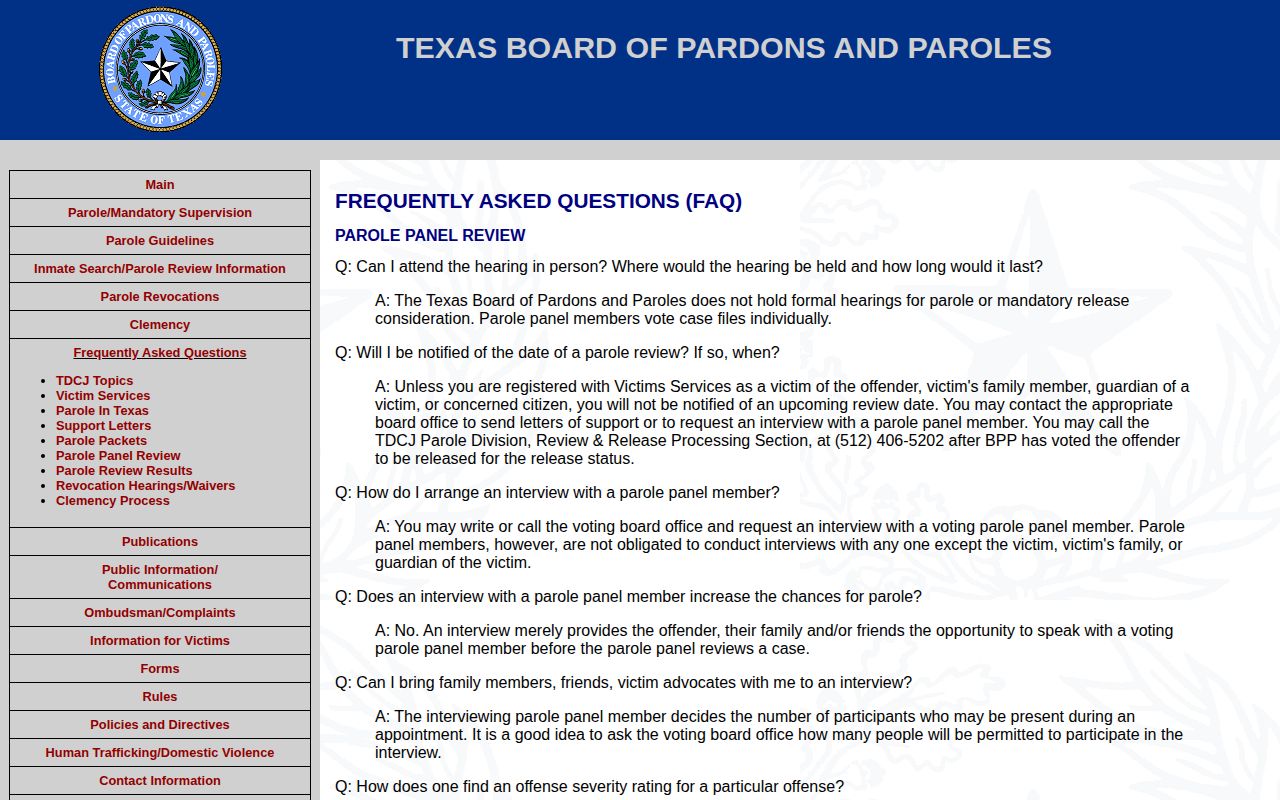
The image supports a file-review workflow, not a public event schedule.
Before a vote, the Board status line is 844-512-0461. After a favorable vote, Review and Release Processing can be reached at 512-406-5202. A favorable vote still precedes checks of the release plan, conditions, disciplinary status, and other required matters before a certificate issues.
Morris County Supervision Violations
Conditions depend on the judgment, release certificate, and supervising authority. Common high-level duties can involve reporting, approved residence, treatment or program work, travel limits, and compliance with the law, but no generic list should be treated as one person's terms. Obtain the filed judgment for probation or the issued state release certificate for parole and mandatory supervision.
A suspected violation does not by itself prove revocation. The supervising authority may investigate, issue instructions, seek a warrant, or begin a formal process. TDCJ maintains a separate public absconder route for covered parole cases. Lack of a public hit does not prove compliance, discharge, or the absence of a warrant. County probation warrant questions belong with the court and Morris County CSCD, not the state parole office.
A new arrest can create another custody episode without ending the older supervision record. Preserve dates and agency names. Compare any warrant or revocation order with VINELink, the sheriff record, and the current custodian before describing the status.
When Morris County Supervision Ends
Supervision ends through a formal act, not simply because an expected date passes. For probation, the court record may show completion, early termination, revocation, or another order. For parole or mandatory supervision, TDCJ records distinguish release from confinement, continued supervision, and discharge. “Maximum expiration” is a sentence calculation label; the actual record must still be checked for other cases, holds, or supervision terms.
If the current TDCJ search has no result, use TDCJ email, telephone, or a focused Public Information Act request for older release and discharge history. The online search expressly covers current TDCJ inmates and updates on working days with information at least a day old. A no-result cannot carry the weight of a discharge certificate.
For a defensible Morris County finding, record the agency, identifier, exact label, and date. Then state only what the source proves: release from confinement to supervision, active probation, a Board vote awaiting processing, or formal discharge. That wording protects the difference between community presence and the end of all legal obligations.
Note: Confirm another case or hold separately before treating one discharge as the end of every custody matter.