
Morris County Projected and Actual Release
TDCJ uses “Projected Release Date” as a defined label. It is the date calculated by the Classification and Records Office on which a state inmate is projected to leave incarceration if parole does not occur sooner. A scheduled release is a later processing label that may identify a scheduled date, release type, and location. Parole eligibility is only the earliest point at which the case may be considered. None of these labels means the person has physically departed.
An actual Morris County release date records the custody event after processing. For Morris County Jail, request the booking-and-release sheet or equivalent jail record. For TDCJ, seek the state release or discharge history. A court order can authorize release, award jail credit, or commit a defendant to TDCJ, but the order time and physical release time can differ.
| Label | What it means | What it does not prove |
|---|---|---|
| Projected release date | TDCJ's current calculation if parole does not occur sooner | Guaranteed release on that day |
| Parole eligibility | Earliest consideration point under the applicable law | Approval or departure |
| Scheduled release | Release processing has advanced to a stated plan | Completed exit |
| Actual release | The custodian records the completed event | Freedom from every hold or supervision term |
| Discharge | The identified sentence or state obligation has ended | Resolution of unrelated cases |
Morris County Detainees Lack Set Dates
A pretrial detainee generally has no computed sentence-release date. Custody may change after bond is posted, a personal bond is ordered, charges are dismissed, a warrant is cleared, or another court acts. A bond amount is not a release appointment. Holds from another county, TDCJ, USMS, or ICE can also change the destination after local processing.
Start with the Morris court case and the jail. The County Clerk handles criminal misdemeanors. The District Clerk handles felonies and court orders. Both direct users to the county's public Tyler portal. Read the signed bond order, dismissal, judgment, commitment, jail-credit entry, or revocation document instead of treating “closed” as a release decision.
For a county sentence, obtain the judgment, sentence start, jail-credit order, and the sheriff's actual release record. Morris County Jail rules mention possible loss of good-conduct credit as discipline, but they publish no earning formula, classification table, weekend rule, or public calculation service. TDCJ rules cannot be applied to a county jail term by analogy.
Lookup a Morris County Release Date
The correct search depends on whether the person is in Morris County Jail or has entered TDCJ. Verify identity with stable numbers whenever possible. A shared name and age are not enough if the offense history and conviction county do not match.
- Identify the custodian. Use VINELink and call Morris County Jail when the last known location was local. A transfer to TDCJ or another agency is not community release.
- Check the court cause. Read the actual judgment and any commitment or jail-credit order through the Morris County court portal.
- Search current TDCJ custody. Enter exact last name plus a first initial, or a TDCJ or SID number, in the TDCJ inmate search. Match the offense and conviction county.
- Preserve the label. Record whether the field says projected, eligible, maximum sentence, or scheduled. Do not rewrite it as actual release.
- Use a second access channel. Email TDCJ with the full name and seven-digit TDCJ number, or exact birth date or approximate age and county of conviction when the number is unknown.
- Confirm completion. Check the holding agency's release record, TDCJ release processing, or a later supervision record on and after the expected date.
The state search screen below is the official interface for current inmates.
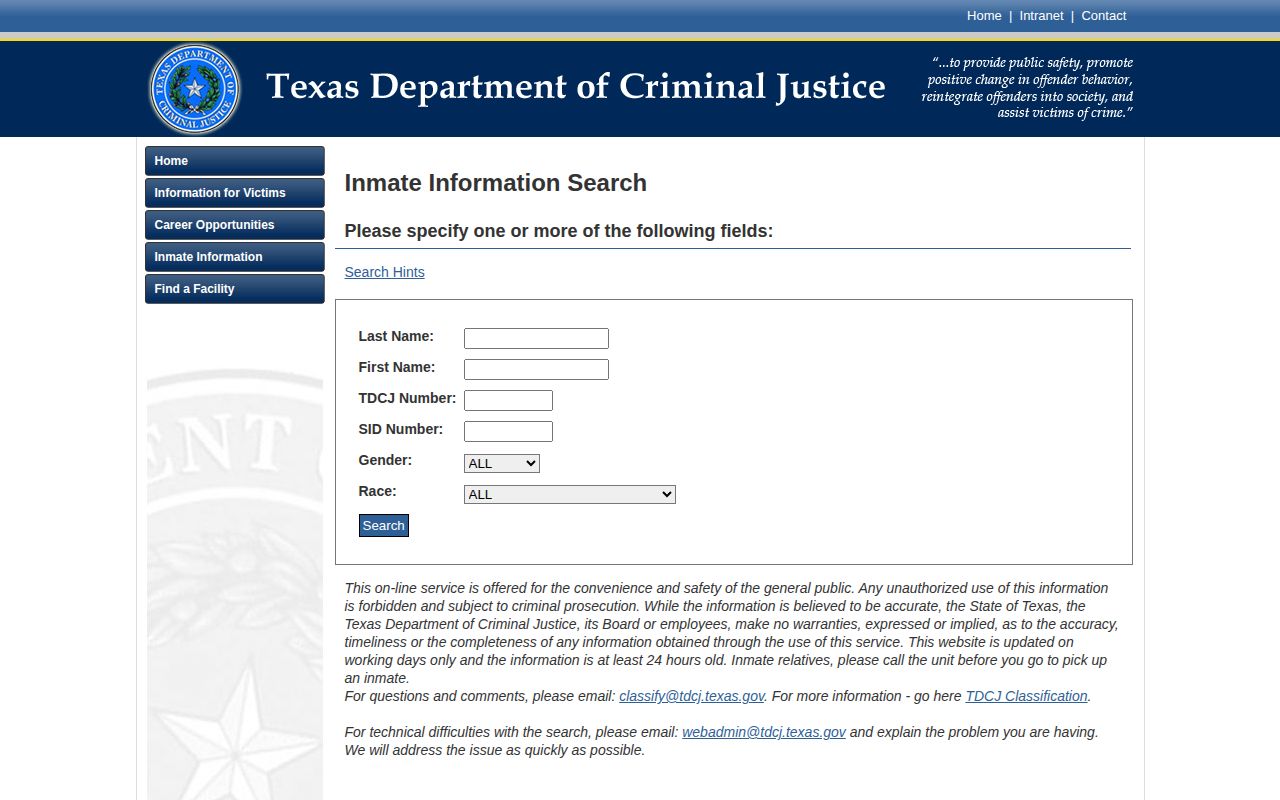
Its own coverage warning matters: a person already released or discharged may no longer appear.
The full county jail search and records chain is explained on the Morris County released-inmate hub.
Morris County TDCJ Date Fields
TDCJ's online results can show name, TDCJ number, race, gender, projected release date, unit, and age. A detail page can add SID, maximum sentence date, current facility, parole eligibility, parole-review information, and offense history. When release processing has moved ahead, a special scheduled-release block may show a date, type, and location. Each field answers a different question.
The online search includes only people currently incarcerated in a TDCJ facility. It updates on working days, and its information is at least 24 hours old. A person who has been released or discharged can disappear from the tool. A no-result also says nothing about a county-only sentence, federal custody, or immigration detention.
TDCJ's basic inmate-information email route can supply the TDCJ number, location, conviction offense, incarceration history, current incarceration, and projected release date without a fee for that listed service. It does not provide photographs or Social Security numbers.
The captured TDCJ email-information page shows the projected-date definition and request route.
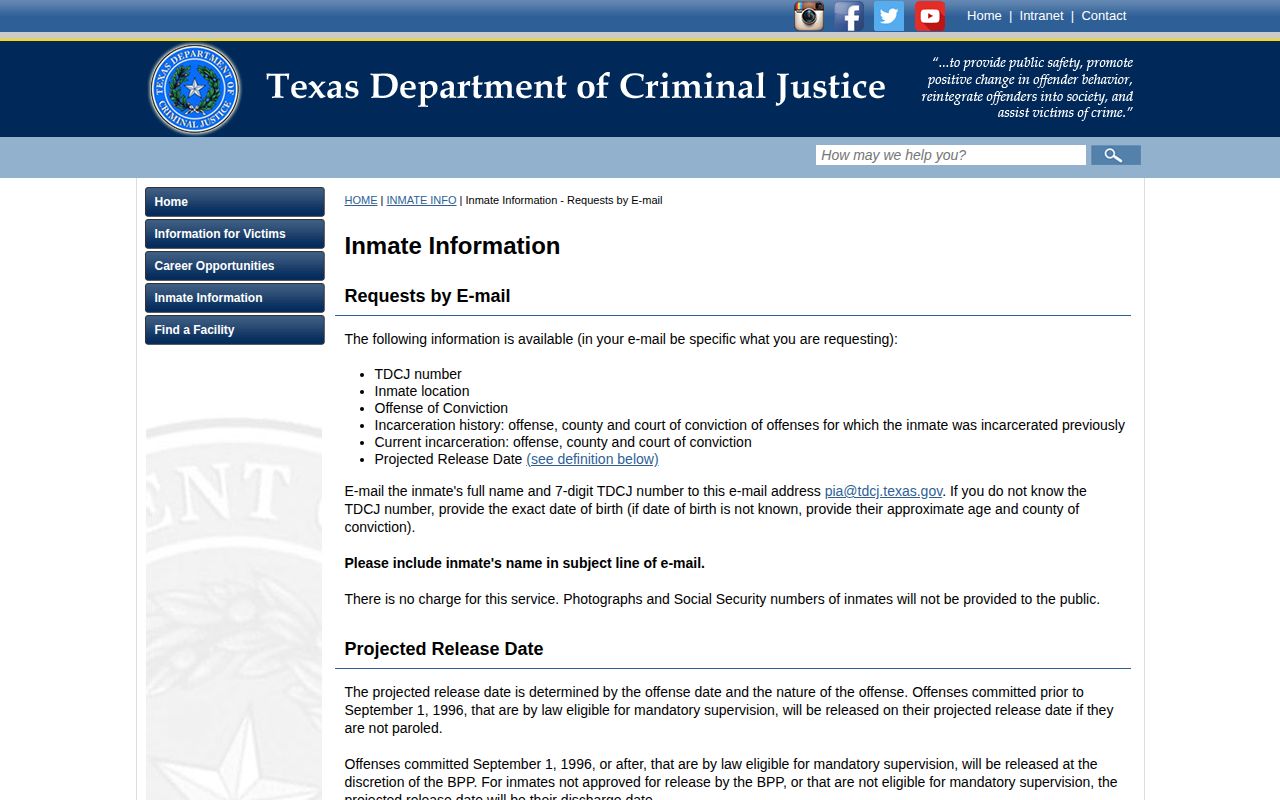
This route is useful when a current search needs clarification, but older release history may require a formal records request.
Texas Good Time and Morris Releases
Texas Government Code Chapter 498 governs TDCJ good-conduct time, classifications, earning rules, forfeiture, and restoration. Good time does not shorten the sentence itself. It can affect eligibility and calculation only as the applicable law permits. Disciplinary action can result in credit loss, and restoration is governed by the state framework rather than a simple arithmetic promise.
Government Code Chapter 508 governs parole and mandatory supervision. Section 508.145 contains offense-date and offense-type rules. Many ordinary cases use calendar time plus good conduct time reaching one-fourth of the sentence or 15 years, whichever is less, while listed serious cases require calendar time and different minimums. Section 508.149 excludes listed categories from mandatory supervision and makes review discretionary for eligible later offenses.
For mandatory-supervision-eligible offenses before September 1, 1996, TDCJ describes a projected calculation in which flat time plus good time reaches the sentence if parole does not happen first. For eligible offenses on or after that date, Board approval is also part of discretionary mandatory supervision. A denial can move the projected field to the maximum-expiration or discharge date. For a person who is not eligible for mandatory supervision, the projected date can match maximum expiration based on flat time unless parole occurs earlier.
These state rules do not create a Morris County Jail formula. The local handbook documents only that discipline may result in loss of credit. Use the jail's calculation, the judgment, and the court's credit order for a county term.
Why Morris Release Dates Change
A displayed date is a snapshot of facts in the agency's records. New legal events and record corrections can change the result. Keep an earlier screenshot or response with its retrieval date, then compare the exact updated label rather than assuming a data error.
| Factor | Possible effect | Best confirmation |
|---|---|---|
| Credit loss or restoration | Changes the TDCJ calculation where credits apply | TDCJ Classification and Records |
| New or corrected sentence | Changes stacked, concurrent, or maximum calculations | Judgment and TDCJ record |
| Jail-time credit correction | Changes time credited toward a sentence | Court order and agency calculation |
| Detainer or warrant | May change the receiving custodian or block community departure | Holding and receiving agencies |
| Board action | Can approve, deny, condition, or later alter release processing | Board code and Release Processing |
| Parole | Can end confinement before the projected maximum path | TDCJ release and supervision record |
| Record correction | Can replace an inaccurate date or identifier | Corrected official response |
Escape status and eligibility changes can also matter. A Board vote is not physical release. Review and Release Processing checks the release plan, disciplinary status, conditions, program needs, and other requirements before a certificate issues.
Confirm Morris County Actual Release
On the expected date, do not rely on the old projected field alone. For Morris County Jail, call 903-645-2232 and request the booking-and-release record. For TDCJ, check the current state detail and use Release Processing at 512-406-5202 after a favorable Board vote. If a transfer is shown, search the named receiver.
VINELink can provide a custody-change alert when the correct person and agency are registered. The alert is a prompt to verify, not a legal certificate. Registration may need to be repeated after a transfer. The Morris County VINE inmate check explains how to match the agency and event.
Phrase the conclusion narrowly. “TDCJ listed a projected release date” describes a calculation. “TDCJ scheduled release to parole” describes processing. “The sheriff record shows release from Morris County Jail” proves that one custody ended, but a receiving agency or supervision record may still apply. Actual status rests on the complete chain.
Note: Record the retrieval date because court orders, credits, holds, and Board actions can change a forward-looking date.